
(Please Note: This page is unofficial, and is not associated in any way with Russell Stover, Whitman’s or any other seller or manufacturer of candies. If you wish to contact the manufacturer, you can find them at the Russell Stover homepage.)
As anyone who has been reading this Blog for any length of time is well aware, I am probably the last person you would want to rely on for any sort of relationship advice, unless for some odd reason you are looking for tips on accomplishing your lifelong dream of living out your life as a hermit living in the middle of nowhere, unblemished by any of that pesky human contact stuff. I think that I would like to at least make an attempt to avoid this scenario, but that’s beside the point for now. I probably can’t (and really shouldn’t) try to advise my readers about how to win the heart of their chosen Mr. or Ms. Right but still need some sort of vaguely seasonal content to tie in with the upcoming Valentine’s Day holiday. Last year around this time, I put together my first annual (or so) Valentine’s Day Kitsch Roundup, and since this year’s collection of heart-shaped and jewel-encrusted merchandise seems to be sufficiently kitschy to warrant such a post once again, I am in the process of collecting the photographic evidence for such a collection once again.
In the process of putting together such a collection, I find myself often staring at shelves full of quality (or otherwise) chocolate confections. The sheer number of different choices to be found on the shelves these days is staggering (as I will discuss in further detail in the upcoming post as outlined above), but among the Johnny-come-latelies and trendy designer chocolates with a pricetag to match can be found the venerable Whitman’s Sampler, an old standby which was around long before most of the other chocolates on the shelf, and will most likely continue to be around long after many of the others have been relegated to the closeout rack of history. Whitman’s was founded in 1842, and has been producing the classic Whitman’s Sampler since 1912, leaving a trail of classic advertisements that remain sought after by collectors. The company also has a long history of supporting the military throughout the various wars they have fought, and during World War II workers in the Whitman’s factory would often add handwritten notes of encouragement to boxes of chocolate being sent to the troops overseas. From the 1960s through the early Nineties, ownership of the company changed hands several times before it finally landed with Russell Stover Candies, where it remains today.

Detail from a 1942 Whitman's ad. Click for the full ad (source: graphic-design.tjs-labs.com)
Unfortunately for the recipient of this charming little box of history, none of this makes it any easier to figure out what’s hiding inside all that rich chocolate coating that your current suitor has presented you with. Oddly enough, I have found that there doesn’t seem to be much information on this topic on the Internet either. As with any other self-respecting company these days Whitman’s has their own website, but it seems to be mostly geared toward selling products by mail order (although if you dig through the Russell Stover site a bit you can find a school project section that provides an overview of the history of Whitman’s,) Information on the actual contents of the venerable yellow box of chocolate seems to be surprisingly hard to come by. The lid of the box includes a “map” naming each type of chocolate in the box (in three different languages, no less) but in spite of this, the whole thing still seems rather vague. While this type of thing might be great for someone with a sweet tooth and a hearty sense of adventure, I figure that there are some people out there who just might want to have a bit more information before they just bite into some random piece of candy.
In light of this (and because I would feel a whole lot less guilty about eating a whole box of chocolates by myself if I could somehow justify it as being for “research purposes,” I have taken it upon myself to dive into the Whitman’s Sampler, try each piece out and report back on my findings. After the jump, you will find the results of my “study” of this classic box of ambiguous confections and brief impressions of each of the various candies found within.
With Valentine’s Day now fast approaching, the number of places in which Whitman’s candies are sold is somewhat larger than usual (although it appears most of those places sell it primarily on a seasonal basis, usually in various heart-shaped containers.) Outside of the Valentine’s Day season, the Whitman’s Sampler can most often be found in various drugstores (I found them in various forms at Rite Aid, Bartell Drug and Walgreen’s stores around here,) usually on a shelf full of various candies. The Sampler comes in a number of sizes ranging from 1.75 ounces (some of which are conveniently giftwrapped for platonic grade school valentine usage) all the way up to a giant 40 ounce box (which is available on the website, but I have yet to see one available at retail.) In addition to the standard Assorted Chocolates version, There are also Milk Chocolate, Dark Chocolate and “Nut, Chewy and Crisp” assortments in 12 ounce boxes. Whitman’s Sampler also comes in a sugar free variety that replaces the usual yellow box with a silver one, and comes in 7 and 14-ounce versions, with a moderately higher pricetag than the conventionally sugared versions. For the purposes of this article, I will be sticking to the standard 12-ounce Assorted Chocolates version of the Sampler, which retails for $9.99 (although I got it on sale for $6.99.)

For Valentine’s Day and Christmas, you will occasionally find these boxes sold in giftwrapped form, which is how this particular box came from the store. There’s a pretty good chance that your prospective Valentine will probably have a pretty good idea of what you’re giving them here even before the wrapping paper comes off the box, but if you’d like here to at least try to act surprised, it might be a good idea to at least take the removable labels (There’s one on the back as well with the ingredients) off the box before presenting it.

There, that’s better. This way, you might be able to get a good 2 or 3 seconds of suspense out of the whole thing.

When the giftwrap comes off, we’re presented with the familiar yellow box inside,

The design has changed over the years every so often, but the trademark cross-stitch design remains. That bird in the upper left corner of the box seems just a bit out of place, but it seems to have found its way onto the packaging of all the various samplers offered currently, so there’s probably some significance to it that is lost to most modern consumers. In general, the decorations on the box seem to be a lot less elaborate than they used to be, which is most likely a concession to modern design tastes. As a side note, when the Whitman’s Sampler was introduced in 1912, it represented the first use of Cellophane in candy packaging (and until 1924, the Cellophane had to be imported from France since nobody in the US had the capability to manufacture it.)

On the back of the box, we find an ingredient list a mile long (which not only covers all of the various ingredients that might have been used to make all of the different varieties of candy in the box, but has to do so in three different languages.) We also see the nutritional information, which tells a story that I suspect most of us probably don’t want to hear. As such, I’ll refrain from pointing out that you would be consuming 1,650 calories and 232% of your daily saturated fat intake if you were to eat the whole box in one sitting (While I worked on this project I staggered out the candy-eating part over several days to try to keep myself from getting too diabetic over the whole thing,) and we’ll just move on to looking at what’s inside the box.

Removing the outer wrapper and pulling off the lid, we find this handy sheet of what is known as the “Pillow Puff” liner made out of embossed paper, another Whitman’s innovation first introduced in 1937. On the bottom of the lid we can see the “map” of the contents of the box, which we will look at more closely in a minute.

Removing the liner, we finally reach the first layer of chocolate in the box.

If we lift this layer up, we find another piece of liner, and a second layer below it, with contents identical to the first layer.

- Click image for a larger version
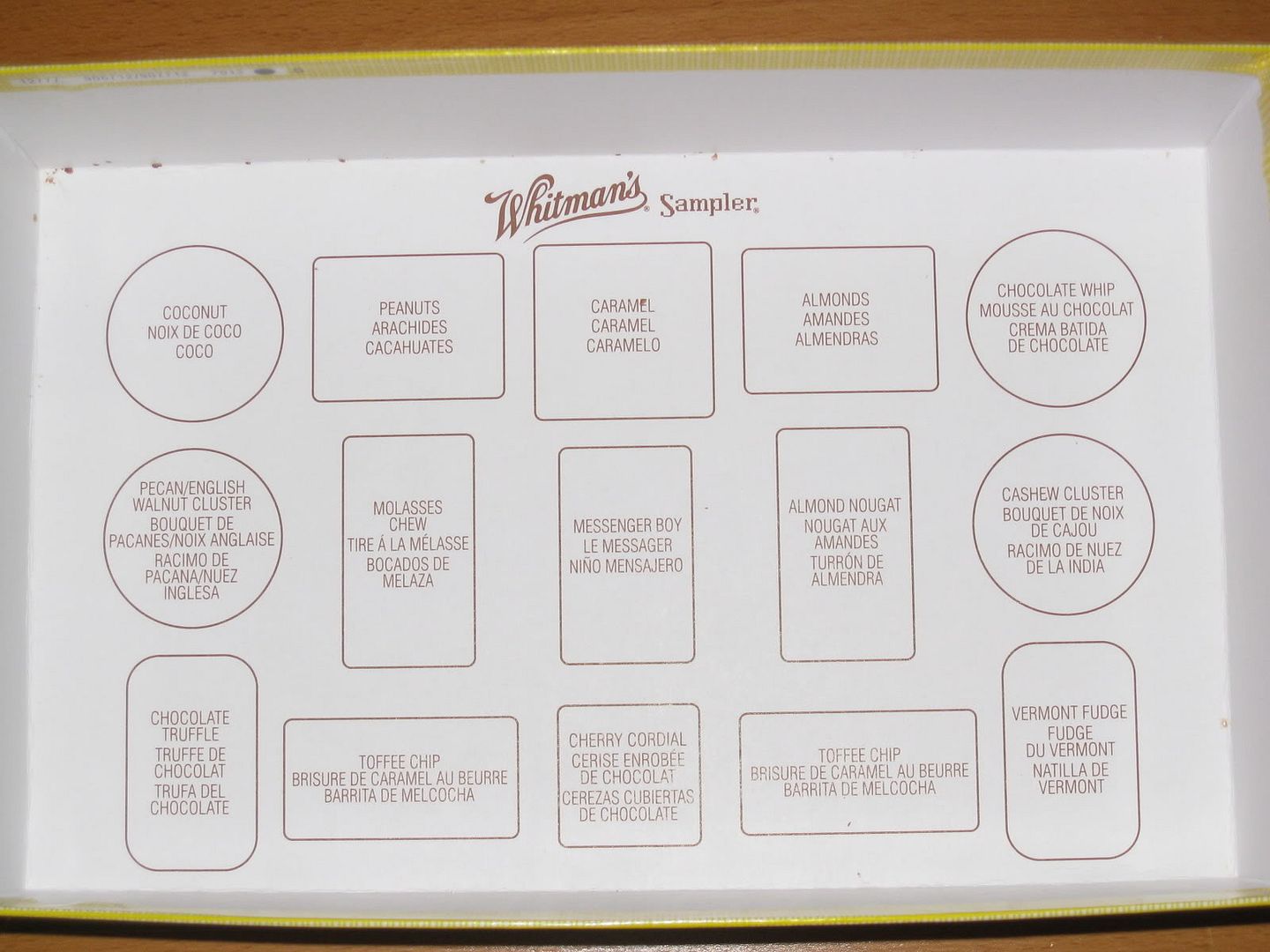
On the bottom of the box, we see the “map” of the chocolates inside the Sampler, with names in English, French and Spanish (it appears that the entire packaging of the Sampler is trilingual these days, presumably to allow it to be sold in Canada and Mexico.) The problem is that some of these names are just a bit vague, and really don’t tell us a whole lot about what’s under the chocolate. In order to help whatever readers happen to wander by this post to make wise chocolate consumption decisions when confronted with a fully loaded Whitman’s Sampler of their own, I have sampled each of the different varieties contained within the box, and my notes and pictures for each one will be included below, in the order shown above Each item will show a photo of the full chocolate, the inside, and some of my impressions from each piece.
#1: Coconut

As we begin with our tour through the various candies found within the Whitman’s Sampler, we’re immediately presented with the first of several similar-looking pieces in the box.

The piece on the left is Coconut, and the one on the right is something known as a Chocolate Whip (which will be discussed a bit further down.) Although I’m guessing there’s supposed to be some trick to allow you to tell these two varieties apart from each other (probably something to do with the ripples on top) for most people who aren’t candymakers at the Whitman’s factory it’s probably going to be a 50/50 chance to pick the correct one out of these two pieces.

As you can probably imagine, the inside of the Coconut piece contains coconut, which means that your enjoyment of this particular confection will depend largely on whether or not you like coconut in the first place. In general I do like the taste of coconut, but I did find this particular piece to be a bit on the dry side compared to other similar coconut-based candies I have tried.
#2: Chocolate Covered Peanuts

To be honest, there isn’t really much to say here. It’s peanuts covered in milk chocolate, no gimmicks involved aside from some what I would guess to be a thin coat of confectioner’s glaze for shine applied in panning. You do get plenty of them though (I didn’t actually count them since I began eating them before I could, but I believe there were somewhere between 12-14 in each layer of the box.)
#3: Caramel

Here’s one of the pieces in the box that actually manages to stand out, at least in terms of appearance. The smooth coat of milk chocolate over a caramel center is distinguished by the lines of milk chocolate that crisscross its surface. It’s also much more squared than other pieces in the box.

In spite of the fancy exterior, the inside doesn’t hide anything, just a center of solid caramel, which remains firm when cut in two, but still manages to be fairly chewy in the mouth. There probably aren’t going to be any major surprises for anyone here.
#4: Chocolate Covered Almonds

Once again, there’s nothing too unusual going on here, just almonds are covered in dark chocolate. The main difference between these and the peanuts is that you get a lot less of these (only three in each layer of the box.) This is a bit of a shame, because I happened to like these quite a bit more than I liked the peanuts. The almonds they used here also seem unusually small compared to almonds you might find elsewhere.
#5: Chocolate Whip

As mentioned above, this particular candy could very easily be confused with the coconut candy found nearby in the box, and there doesn’t seem to be much to distinguish the two from each other. Both are similar in shape, and covered in milk chocolate. The actual contents of the two pieces are very different from each other though.

The “whip” part inside the Chocolate Whip is a light, airy nougat that is presumably flavored as chocolate, although to be honest, I found it just a bit difficult to discern exactly what flavor this was. If it’s eaten with the chocolate shell, you’ll mostly taste that. If you try to eat the nougat by itself, it doesn’t necessarily taste like chocolate. In fact, I seemed to detect a faint hint of some spice I couldn’t place. You’ll just have to try this one for yourself to figure it out. For most people, this piece is going to be more interesting for its light airy texture than for its taste though.
#6: Pecan / English Walnut Cluster

As we begin with the second row of the box, once again we’re presented with a pair of items too similar in appearance to discern by looks alone. On the left side of the box is the Pecan/English Walnut Cluster, and on the right side is the similar looking Cashew Cluster. Both of these are small paper cups filled with milk chocolate and nuts, and both look basically identical when shown side by side.

For all the good that it does, the one on the left is the Pecan / English Walnut Cluster, and the Cashew Cluster is on the right. Aside from the appearance that the Cashew Cluster might have a bit higher density of nut pieces, once again you’re pretty much on your own here.

As for the Pecan/Walnut Cluster, I’m not sure if the pecan and walnut content is supposed to be an either/or thing or if it’s supposed to contain both, but I was able to taste more walnut than pecan. It does look like there are pecan pieces in here though, although it’s tough to tell the difference from here. Either way, you’re dealing with chocolate-covered nut pieces, so there shouldn’t be any surprises here.
#7: Molasses Chew

Now we come to another of the more distinctive pieces in the box, the Molasses Chew. Covered in smooth dark chocolate with elegant white zigzag stripes, there’s nothing else in the box that even looks close to this one. In fact, this piece almost begins to seem a bit out of place compared to many of the more roughly textured pieces found throughout the box.

For those people who take the time to actually look at the inside of the piece, you are rewarded with a surprisingly complex ring pattern in the nougat, presumably a by-product of the method by which the centers are formed. The texture, as expected by the name, is very firm, but not so much as to be considered hard. In terms of flavor, this is another one which could be a bit of an acquired taste for some people. Molasses is a flavor that seems to have long since fallen out of the typical American palate, and might seem a bit odd. It sure is pretty to look at though, isn’t it?
#8: Messenger Boy

Before you ask, no this isn’t made out of real messengers. In fact, this particular piece isn’t made out of anything but plain milk chocolate with nothing else inside. It does, however, act as something of a signature piece for the box, and shows the Whitman’s “Messenger” logo, a common feature in their advertising for many years. In fact, the timeline on the Whitman’s site specifically mentions the addition of this piece in 1915 a couple of years after the Sampler was originally introduced to recognize it as being Whitman’s best selling product. It also gives you a chance to try out the chocolate without anything else getting in the way.
#9: Almond Nougat

In terms of appearance, the Almond Nougat piece seems to bear some resemblance to other pieces in the box, but unlike several of the ones discussed already, it can be easily distinguished from similar looking pieces by its shape, which is a bit longer and more squared than anything else. I am not entirely certain why the top of this piece seems to only have the wrinkles on half of it, but this seems to be an exception rather than the norm for this piece, since the other one in the box seems to have the pattern over the whole surface.

On the inside, we have nougat with almonds inside of it, just as advertised. I found in my tasting that the almonds seem to get just a bit lost in here, and if I didn’t know they were in there, I could have missed them entirely. The almonds will probably assert themselves more as a crunch on the inside than as a flavor. The nougat itself is pretty generic.
#10: Cashew Cluster

This was briefly discussed already in comparison to the Pecan/Walnut Cluster piece that it shares its general appearance with, likely to the confusion of some consumers. What we have here is milk chocolate with cashew pieces in it, plain and simple.

I’m not normally a fan of cashews (I generally prefer peanuts for snacking on,) but I actually liked the taste of this one more than I expected to. The cashew pieces have a nice roasted flavor to them, and don’t seem to get overwhelmed by the chocolate coating nearly as much as the centers of some of the other pieces do. The fact that there seems to be more cashew in here than there is pecan and walnut in the Pecan/Walnut Cluster probably helps with this significantly.
#11: Chocolate Truffle

As we move onto the last row, we run into one more set of nearly identical looking candies, Chocolate Truffle and Vermont Fudge. Fortunately, these two are a bit easier to tell apart than some of the others.

The Chocolate Truffle is on the left in milk chocolate, and Vermont Fudge is on the right coated in dark chocolate (something that there doesn’t seem to be nearly enough of in this box if you ask me, but that’s beside the point.)

It seems like everywhere you look these days you find truffles in one form or another. Everyone and their dog seems to be making the things these days. A couple of years ago I even made some of the things at home once or twice in my own kitchen, and although the results turned out reasonably good, I think I managed to make the second biggest disaster ever out of my kitchen in the process (and the first involved setting something on fire,) so now I just prefer to leave such things to the professionals. As for this one, the center is made of dark chocolate, and unlike the Chocolate Whip, it actually tastes like chocolate. The Ganache layer might not be quite as smooth as some truffles, but it works. I should note that although the cut in the picture above makes it look like there’s multiple layers, the center is consistent all the way though.
#12: Toffee Chip

The first thing you’ll notice about the Toffee Chip is that unlike any of the other pieces, there are actually two of these in each layer. Exactly why they picked this particular piece to add a duplicate of I am not sure, but if they did have to pick one to duplicate, I’d say that this one was a pretty good choice.
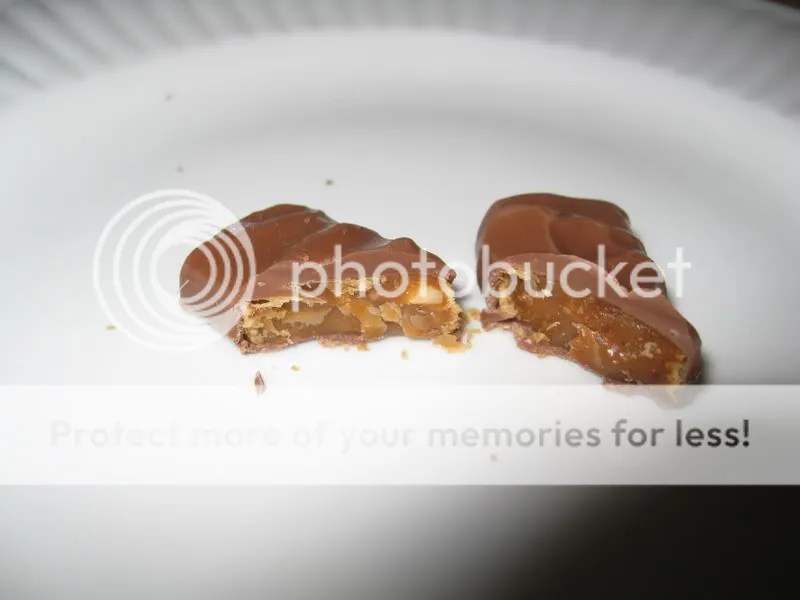
As you would expect from the name, it’s toffee covered in milk chocolate, and it appears to contain almond pieces in it as well. The toffee used has a nice buttery flavor, and I’d even say that it compares favoably to the toffee used in the local favorite Almond Roca, the standard for toffee-based candies around here. Of all the pieces in the Sampler that I have tried, I’d have to say this one just might be my favorite.
#13: Cherry Cordial

Cherry Cordials are one of those candies that it seems that people either love or hate. In my case, I find them to be somewhere in between, one of those things that seems like it would be good every so often (usually when they’re on closeout after one of the big candy-selling holidays), but after eating one or two of the things I seem to find myself wondering why I ever thought that would be a good idea in the first place.

The example found in the Whitman’s Sampler is a fairly typical representative of the genre, although for some reason the cherry in the center of this one seems to be oddly translucent, as you can see in the picture. On the plus side, it doesn’t seem to have the extra bit of sugar slurrry in the bottom that some Cherry Cordials have which just seems to be a waste of calories (more so than the things are in the first place, anyway.) If you happen to like the things, you’ll probably like this one. If you don’t, at least this one is distinctive enough that you’ll be able to skip it without too much problem.
#14: Vermont Fudge

Finally, we come to the last piece in the box, the Vermont Fudge. Before we even crack open the chocolate shell we’ve already got a number of questions. Aside from the fact that only the dark chocolate shell distinguishes it from the Chocolate Truffle on the other side of the box, we’ve also got the question of how Vermont Fudge ended up in here anyway. After all, Whitman’s originated in Philadelphia (but the manufacturing facilities appear to have moved to Kansas City after the brand ended up under the Russel Stover umbrella,) and Vermont is a fair distance away. There’s also the fact that when you think of fudge, generally you’re going to be thinking in terms of chocolate.

When we cut this one open and take a look inside, we seem to get a different story entirely. I’m pretty sure that chocolate doesn’t generally come in that color, fudge or otherwise. Only when we actually taste the filling does the whole story come together here: The “fudge” inside this one is actually maple flavored, which would explain the “Vermont” part of the Vermont name. For all I know there might not be a single ingredient in this stuff that has been within five hundred miles of Vermont and still the name almost makes sense. Almost.
So there you have it. All fourteen varieties of candy found in the 12-ounce Whitman’s Sampler dissected and analyzed. As mentioned above, there are a number of other varieties of the Sampler (including all milk and dark chocolate versions of the original and a sugar free Sampler,) so I could probably discuss those in further detail. Maybe I will at some point, but after working on this particular project I’m getting just a little bit sick of candy right now. Hopefully those of you reading this, either because you have received one of these or because you are planning to give one as a Valentine’s Day gift, will be able to appreciate it a little bit more by knowing a bit more about what’s inside. After all, as the classic Whitman’s slogan says, a woman never forgets the man who remembers (although I think that would apply just as much for a guy actually doing the dishes every once in a while as it would for buying candy for your chosen sweetheart.)


 The Sledgehammer - Version 2.0
Haha. I didn’t think I’d actually find anything this detailed on Whitman’s Sampler. It’s always nice to get a bit of history, though.
Comment by Russell — February 12, 2009 @ 8:12 am
What ever happened to the vermont fudge that i enjoyed years ago. A favorite of my wifes.
The piece had a green outer layer and a creamy smoth center.
Comment by haroldgamble — February 15, 2009 @ 11:08 am
Nice review, but…
…is it just me, or a couple years ago was there a LOT more chocolate in these things? If I remember right, the Sampler I adored as a kid doubled up not just on the toffee (which was actually quadrupled), but EVERYTHING.
Comment by Indigo_X — February 22, 2009 @ 10:39 am
Well, there are two identical layers of candies in the 12 ounce box reviewed here, so there are four pieces of toffee chip in the box. The larger boxes may have more of each candy.
Comment by Brian Lutz — February 22, 2009 @ 1:02 pm
Perhaps, but, if you look at the ad from 1942, you can see that the box in question was pretty much crammed with candy — nowadays, it seems more a triumph of the molded plastic tray’s ability to fill space with air rather than candy.
Comment by James David Walley — December 13, 2009 @ 1:12 am
This is such a great posting! Thanks for the effort. I’m a huge fan of Whitman’s and I’m just mentioning it off-the-cuff on my own blog, and I’m linking to this, because clearly, this is THE definitive treatise on Whitman in the blogosphere.
Comment by Blaiser — October 14, 2009 @ 9:49 am
Whitman has meant relationships since I was a kid in 1950. I had called Walgreens the other day and asked for the candy in the yellow box. The lady knew what I meant. cool, yes1
Comment by helene Machac — October 27, 2009 @ 6:43 am
I just found a box of whitmans chocolates from last Xmas…are they still good to eat
Comment by julie palmer — November 21, 2009 @ 8:56 am
i don’t think so,unless candy is in tin box,good luck.
Comment by linda harris — March 11, 2012 @ 11:10 am
Hallelujah!!! Not only couldn’t I find what was in the Whitman’s sampler, I couldn’t find anything that would tell me types of CHOCOLATES – not chocolate (as in semi-sweet, milk chocolate, dark). Not only do you tell, you show! Gorgeous pictures! Just a beautiful Blog all the way around. My daughter graduated from Whitman College in Walla Walla Washington. She gets a Whitman’s Sampler for every occasion. She says that if she had known it was buying her a life of chocolate she would never have considered going anywhere else. She tried to find a Dom Perignon University for her PhD, but to no avail. Thanks for this!
Comment by Winnie Cross — December 17, 2009 @ 1:45 am
I seem to recall that someone had published a Whitman Sampler design in cross stitch. Do you know if the pattern is still available and where?? Thank you very much.
Comment by Pat Harding — December 23, 2009 @ 10:17 am
I recently received a re-gifted box of your chocolates, and they seemed really, really old. The coupon inside did not have an expiration date, but the scanner number under the bar code is 76740 97476. Under the second bar code the numbers are: (8100)0 119174.
Can you tell me when you boxed these chocolates?
Many thanks!
Sharon Whittlinger
Overland Park, KS 66212
Comment by Sharon Whittlinger — January 22, 2010 @ 8:56 am
What a fun and informative blog. I LOVE the molasses chew by Whitman’s contained in their sampler box…and wish they sold it on it’s own. Even though Whitman’s is now owned by Russell Stover Chocolates, the box of Stover’s molasses chews tastes nothing like Whitman’s…disappointing. And really, would kill them to include the ubiquitous foil wrapped chocolate covered cherry in their Sampler assortment??? Everyone knows women LOVE chocolate covered cherries! (Cella’s are the best- far superior to others on the market).
Comment by Lynnz22 — February 9, 2010 @ 8:22 am
just needed to express my opinion,I have been eating whitman chocolates for over 30 years and was very dissappointed this past valentines day when I recieved the large box wrapped in beautiful red paper It was stale very old and hard.I know times are hard but for people to continue to buy your product you need not to sell it for the following holiday just because it didn’t sell.
Comment by lesa wilkins — February 16, 2010 @ 2:10 pm
[…] for the completely pornographic and technical version of this piece, please visit https://thesledgehammer.wordpress.com/2009/02/02/sampling-the-whitmans-sampler-a-guide-to-americas-fa… […]
Pingback by Instructions for enjoying the Whitman’s Sampler Chocolate Box. « Myddle — March 10, 2010 @ 3:05 am
Can anyone tell me what it cost (roughly) to buy 5 pounds worth of Whitman’s chocolates around 1955-60? That was a time when university women used to celebrate a “pinning” with a 5-pound party and an engagement with a 10-pound party. I am trying to compare chocolate prices then with what the same event would cost today. I don’t need pinpoint specifics… A good estimate would be fine. Thanks.
Comment by Tom Emmerson — April 26, 2010 @ 8:12 am
In response to your question I went and did some digging around in the Google News Archives around February of 1959 and 1960, and although I wasn’t able to find any prices for a Whitman’s Sampler specifically, ir looks like chocolates generally ran somewhere in the neighborhood of $1-2 a pound back in that era depending on quality, although $1.59 seemed like a common price for a quality 1-pound assortment.
Comment by Brian Lutz — April 26, 2010 @ 11:30 pm
I’m actually giving a box of Whitman’s assorted chocolates as an apology gift to the nurses at the clinic I go to. I was a little rude today and feel bad so I just want to let them know that I appreciate everything they do for me. I hope I get forgiveness :)
Comment by Kristal — June 15, 2010 @ 11:17 pm
I would like to buy some molasses chews and i can’t find them anywhere.Please help. Big craving.
Comment by Suzanne Blakey — August 3, 2010 @ 12:43 am
Try this:
http://www.russellstover.com/jump.jsp?itemID=148&itemType=PRODUCT
You can also build a custom box with whatever combination you like. I did that for my girlfriend one year and she loved getting just the 2-3 pieces she really likes.
Comment by David — August 19, 2010 @ 11:57 am
I received a 24 oz. box of Whiteman’s Sampler, much to my delight until I looked inside the lid and found that there are only three rows of chocolates identified but there are five (5) rows of chocolates. What’s up with that? I may as well put them all in a blender and eat them with a spoon. Soooooooooo diasappointed.
Comment by Dolores Smart — November 15, 2010 @ 11:30 am
This post was based on the 12-ounce Whitman’s Sampler Box, which seems to be the most common size available. If there is enough demand I may revisit this for larger boxes, but I am not sure whether or not there are additional types of pieces in the larger boxes or not.
Comment by Brian Lutz — November 15, 2010 @ 12:13 pm
thanks so much for this great post! I’m writing Christmas Remembrances of my 1940’s childhood -when kids gifts were practical and mostly hand-made; knitted mittens, caps, scarves, etc. Store-bought toys and candies were rarely under the tree. The thrill I felt when grandma’s unwrapped gift revealed distinctive yellow box of Whitman’s Assorted Sampler is still with me; as is the disappointment I supressed when lifting the lid revealed the familiar knitted mittens. I had momentarily forgotten that gift boxes were,like everything that could be, recycled. I spent the rest of day nibbling home-made candies and trying to imagine that they tasted like those listed inside the lid. Cherry cordials defied my imagination and the idea of their taste very tantalizing when my teetolling family said cordials had liquor in them. Definitely not for kids. I couldn’t wait to grow up and taste them, an experience that, alas, didn’t live up to expectation! Thanks again for bringing back the memory so vividly.
Comment by dorothy — December 16, 2010 @ 6:13 pm
I am looking for your smallest little samplers to give as small gifts to friends. What is your pricing for say a case or two of the tiny boxes and tins?
Comment by Paul Whitman — December 27, 2010 @ 11:35 am
Please note that this page is unofficial, and I am not affiliated with Whitman’s in any way. That said, the smallest size Whitman’s Sampler available is the 1.75 ounce size, which is often available in drugstores, or can also be found here:
http://www.russellstover.com/jump.jsp?itemID=467&itemType=PRODUCT&path=1%2C2%2C5%2C216&iProductID=467
Comment by Brian Lutz — December 27, 2010 @ 1:34 pm
picture can not been seen tanks also
Comment by laser cutter — February 22, 2011 @ 12:42 am
My daughter kindly gave me a Sampler box for Father’s Day.
I’ve had a couple so far and it’s got to be the best I’ve ever had !
Your review is very helpful thanks.
Comment by Kevin Hammond — October 5, 2011 @ 6:30 pm
I couldn’t find a suitable place to vent my complaint but what the heck??? The 40 oz box of Whitman’s samplers has the impression that their are two layers!! I’m upset! Freeking deceptive marketing! I hate it! I mean the box is deep and it looks like your getting a lot….but your not! 19.99 at Kmart…. this big box and you say wow! But it’s a big let down….. freeking put it in a smaller box and make two layers or something you lying sacks!!
Comment by HorseCrud — November 21, 2011 @ 10:57 am
When did Whitman’s Sampler forego the little boxes with brown pleated papers which held the candies and move to the moulded,
plastic’ type liner which now holds the individual candy. Anyone know? As a child; loved the smaller boxes inside the ‘sampler’.
These box dividers;holding candies in pleated papers;are now gone; and perhaps ‘long gone’ – at least according to my daughter/lol; but am wondering ‘what year’ did they disappear?
Comment by Cathy in PVB — December 24, 2011 @ 6:30 pm
In the 24 oz. box, the “map” of the chocolates looks alot like the one in your 12 oz. picture; (except that it is only in english, and the “Vermont Fudge” has been renamed as “Maple Fudge”).
The map in the 24 oz. box is still 3 pieces tall, and 5 pieces wide, but the candy in the 24 oz. box is 5 pieces tall and 6 pieces wide, so it is the the wrong map.
It’s a 12 oz box map printed inside the 24 oz box.
Comment by zzzhuh — January 14, 2012 @ 9:50 pm
I would buy my wife a Heart of Chocolates every year…only she loved the Valentines day hearts that were YELLOW…not Red. They stopped making Yellow Hearts of Chocolates back in the 1970’s, and how I’d love to suprise her AGAIN with a yellow, satin & ribboned Box of Chocolates!
Comment by Steve — February 6, 2012 @ 6:42 am
[…] libation for spending the night in, perhaps with a gourmet selection of Chinese take-away. Add a Whitman’s Sampler and the double Snuggie: the rest is up to […]
Pingback by Tipple d’Amour: Valentine Wine « Good Booze — February 14, 2012 @ 7:48 am
a great coverage, even if it does expose the flaw in the Sampler selection that there isnt really much variety in the taste and too many are anonymous brown inside. I recently bought a 40 oz box (yes some shops do stock them!) for my 94yo aunt and we found the problem that the selection key was printed under the box, so you could only identify an item by holding the box over your head or turning it over
Comment by karl lorenz — July 24, 2012 @ 5:56 pm
[…] DaizyStripper, this is simply the modus operandi.With six tracks in all, Humaloid is rather like a Whitman’s Sampler, a chocolate box where each piece is made of fine quality chocolate; all tasty, all […]
Pingback by Another success for Daiyztripper with Humaloid » Visual Kei Music, Life, & Japanese Fashion » ROKKYUU Magazine — August 9, 2012 @ 9:49 pm
Talk about skimpy. Where’s the two jordan almonds that sat proudly off to the center? What about the jelly centered chocolate?
I’d rather remember Whitmans from my childhood.
The greedy owners have bastardized a wonderful thing.
Comment by Caroline — August 20, 2012 @ 1:44 pm
Looking for a buy one, get one free, since my family goes through a lot of boxes during Christmas holidays.
Comment by Dee — November 19, 2012 @ 12:22 pm
The “Chocolate Messenger Boy” that was in the one we just got here at the office was NOTHING like the one pictured and described above. It was the BEST piece in the box and had a light, airy filling and was great! Not just the “piece of chocolate” as listed above. I WANNA KNOW WHAT I ATE AND WHERE I CAN GET MORE!!!
Comment by skeebwilcox — November 26, 2012 @ 8:44 am
Can you tell me if the 24 oz box has the same chocolates in it? I bought one and it did not have the graphic showing what types of chocolates are in it? Thanks for any info. V. McClellan
Comment by V. McClellan — December 3, 2012 @ 5:46 pm
What kills me the most is that I remember Whitmans Samplers having much more of a selection just a few years ago. There are only about 14 different pieces you can get now, unless you count dark and milk chocolates separately. What happened to all the better pieces, the Mocha Creme Shell, the peanut butter cup, the marshmallow filled, and my personal all time and most missed favorite, the Chocolate Meltaway (so good they only gave you one per box, even in the 2 lb assortment). And the Chocolate Whip is NOT the same, the Meltaway literally did melt in your mouth, it was pure heaven. I even remember where it was….in the bottom right hand corner usually on the bottom layer. Wonder why they only gave one? One piece I don’t miss was that disgusting, thick, gummy Raspberry Gel. You couldn’t give that one away! Does anyone know of any sites that talk about the assortment history of Whitman’s, not just the company history? I’d like to see a look back at what USED to be in the boxes, instead of this paltry assortment they give us nowadays.
Comment by Jason P in Savannah GA — December 28, 2012 @ 11:46 pm
I loved that Raspberry Gel. Miss it terribly. It was my favorite. I’d buy a whole box of chocolates just for that one. Yes, you could have given it away, to me, lol. Unfortunately, I can’t find it now.
Comment by Debra B. — December 23, 2015 @ 4:57 pm
And the mint jelly one was so good too….I miss the bygone era of Whitman’s Sampler. I bought one for my son this Valentine’s day and was so disappointed to see if only had a small selection. I remember when both levels were different and my grandmother would make me wait until the top section was eaten before we could start the next layer…..
Comment by Christy B — February 16, 2017 @ 11:53 am
I’m interested in finding the candy that was milk choc covered gel on the inside. Maybe raspberry or strawberry. Is that still available? I loved it the most.
Comment by Carolyn Gara — January 3, 2013 @ 3:01 pm
The Razz gel was my favourite too!!!!
Comment by vann — February 14, 2015 @ 6:34 am
I got a Christmas sampler in a cute tin. It’s way more plastic tray than chocolate but the real problem is there is nothing on the lid or paper to tell me what the heck anything is! I’ve taken bites off several and put them back already, lol. Then I found your guide and tried to find something I’d like. I ended up eating just a couple and still I am feeling so very sick that at this moment I never want chocolate ever again! I guess I just don’t like Whitman’s lol… It was on sale..
Comment by Julie Lynn — January 3, 2013 @ 11:32 pm
This was fantastic!!! I’m working on a new talk and wanted to find info on the Whitman’s Sampler – and – tada! As a blooger on choclates, I admire all the time and work this took. Thanks so much for such a great post!!!
Comment by Denise Ryan — January 9, 2013 @ 12:05 pm
I grew up seeing these beautifull boxes with plastic flowers on them and huge boxes with like it seemed a hundred pieces of chocolate and. differant flavors to eat in them now its like square boxes that u see everyday in drugstores its not anything special to get something u see everyday its special to get something pretty and differant in a heart shaped box miss them
Comment by kathy kimmons — February 3, 2013 @ 10:27 am
I really love love love your extremely detailed description here. I searched high and low for one that could explain and show the different candies. I don’t know why but our 100th anniversary Whitman’s tin did not include a guide or index map of the candies. And I gifted this for my husband and he’s very anal retentive. Thanks again so much!
Comment by mekinla — February 14, 2013 @ 9:01 am
I recently purchased a giant box of the sampler after Valentine’s Day…yeah, 50%off. Anyway, I was extremely disappointed in the variety. Not near the choices that I remember from years ago. Yes, no jelly filled chocolate! Mostly caramels. Toffee was by far my favorite. I won’t be buying again anytime soon, at any size.
Comment by Where's the Jelly!? — February 22, 2013 @ 7:20 pm
Thank you for posting this. Someone brought a box into our office. I have never tried Whitman’s, which made me feel un-American. =). I wanted to know which pieces to choose. So far, I liked the chocolate covered almonds (hard to mess up), the molasses chips, and the messenger boy. The Vermont Fudge isn’t bad either. Thanks for guiding me through this piece of Americana.
Comment by Cheryl — April 19, 2013 @ 3:37 pm
The piece of hair on the plate in photo 6-7 is not appetizing. I thought it was on my iPad and I kept swiping it! I’m hoping it was not found found in the box!!!! Loved your blog. Was looking for information about the ‘map.’ When did Whitman start including the ‘map?’
Comment by Martha — August 23, 2013 @ 3:29 am
Piece of hair, huh. How about 30 to 50 or more live bugs crawling in the box and over the candy. Opened a Sampler box after Christmas and 4 days later these bugs must have hatched or maybe they were there and I didn’t notice right away. UGH. Filled out company form. Never got a response. Called company Jan 3 and rep’s response was “S*** happens – oh well”. Always liked Whitman’s and Stover, too, but never again. Can’t get that image out of my head of the all those bugs crawling in the box.
Comment by Janey — January 11, 2014 @ 5:30 am
Love your blog page, this is the most detailed analysis of my my favorite candy I’ve ever seen on the net. I remember Whitman’s Sampler when I was little boy (I’m in my 50s now). I agree Whitman’s has changed big time over the years. My favorite used to be “Liquid cherry”, which was replaced by the so-so cherry cordial.
I found this picture online of an old Whitman’s box…check out the candy map, there’s almost nothing like that in the modern box: http://ralphus.net/dailypic14/WhitmanSamplers3.JPG
Comment by Dave — February 11, 2014 @ 8:51 pm
[…] indulge in the bittersweet moments of your romantic past that have led you to this moment. Refer to this guide if you’re unfamiliar with the types of chocolates in the variety sampler […]
Pingback by A Bittersweet Valentine's Day — BlogDailyHerald — BlogDailyHerald — February 12, 2014 @ 9:00 am
I remember passing the Whitman’s factory just outside of Darby, PA on the Woodland Avenue trolley in the 1950’s. I went to a school that was built in 1873, and this factory looked about the same age. Around 1960, the employees went on strike. The family then sold the product line to a large manufacturer in Chicago, and quit the business. It was a sad time for the community to see it close. I believe they purchased their chocolate from Wilbur Suchard in Lititz, PA.
Comment by David R. Morrison — May 19, 2014 @ 7:03 pm
Thank you for your selfless dedication to research. ;) I found this while doing (rather less tasty) research of my own — I’m writing a short story (fiction) that features a box of Pangburn’s chocolates, and wanted to know what to call the quilted paper liner that keeps the chocolates from getting bruised. On your authority, I’m calling it the “pillow puff.” Now I just wish it had occurred to me to actually buy, and eat, a box of chocolates as part of my research! Ah, well, next time …
Comment by L. A. Nicholas, Ph. D. — July 17, 2015 @ 2:13 pm
the vermnt fudge was in the little ambassadors chocolate box from russell stover. you can’t get it from russell stover anymore. it was in dark and milk chocolate. it was my favorite piece in the box. nice to see it in here.
Comment by christine — December 21, 2015 @ 9:20 pm
[…] so often, you come across a beer from a brewery that you’ve never heard of. Much like the Whitman Sampler, you don’t know if you’re going to like a particular chocolate confection until you […]
Pingback by Beer Review – Golden Road Saison Citron – It's just the booze dancing… — June 22, 2016 @ 8:01 am
I got my daughter an Elf back in the 60’s that came on a box of Whitmans. She is 57 now and proudly displays on her tree. I would love to know what year they came out.. Thank you
Comment by Linda Chiangi — December 5, 2016 @ 7:28 am
Hi, i hv a box of these gorgeous chocolates, but i need to know whether it contains any animal product. Please guide me, thanks in adv.
Comment by Maliha — December 5, 2018 @ 10:03 pm